
Introduction
Have you ever walked into a room and forgotten why you went there? Or found yourself reading the same paragraph several times because your mind kept wandering?
If so, you’re not alone.
Many people struggle with memory and concentration from time to time. A busy lifestyle, stress, lack of sleep, and constant digital distractions can make it harder to stay focused and remember important information.
If you’ve ever wondered why memory problems happen, you may also find our article on Why Do We Forget Things? 10 Common Causes of Memory Problems helpful.
The good news is that your brain benefits from regular practice. Just like your muscles become stronger through exercise, your brain can improve when you challenge it with activities that encourage learning, problem-solving, and concentration.
You don’t need expensive equipment or complicated programs to get started. Small daily habits can gradually help improve mental sharpness and make it easier to stay focused throughout the day.
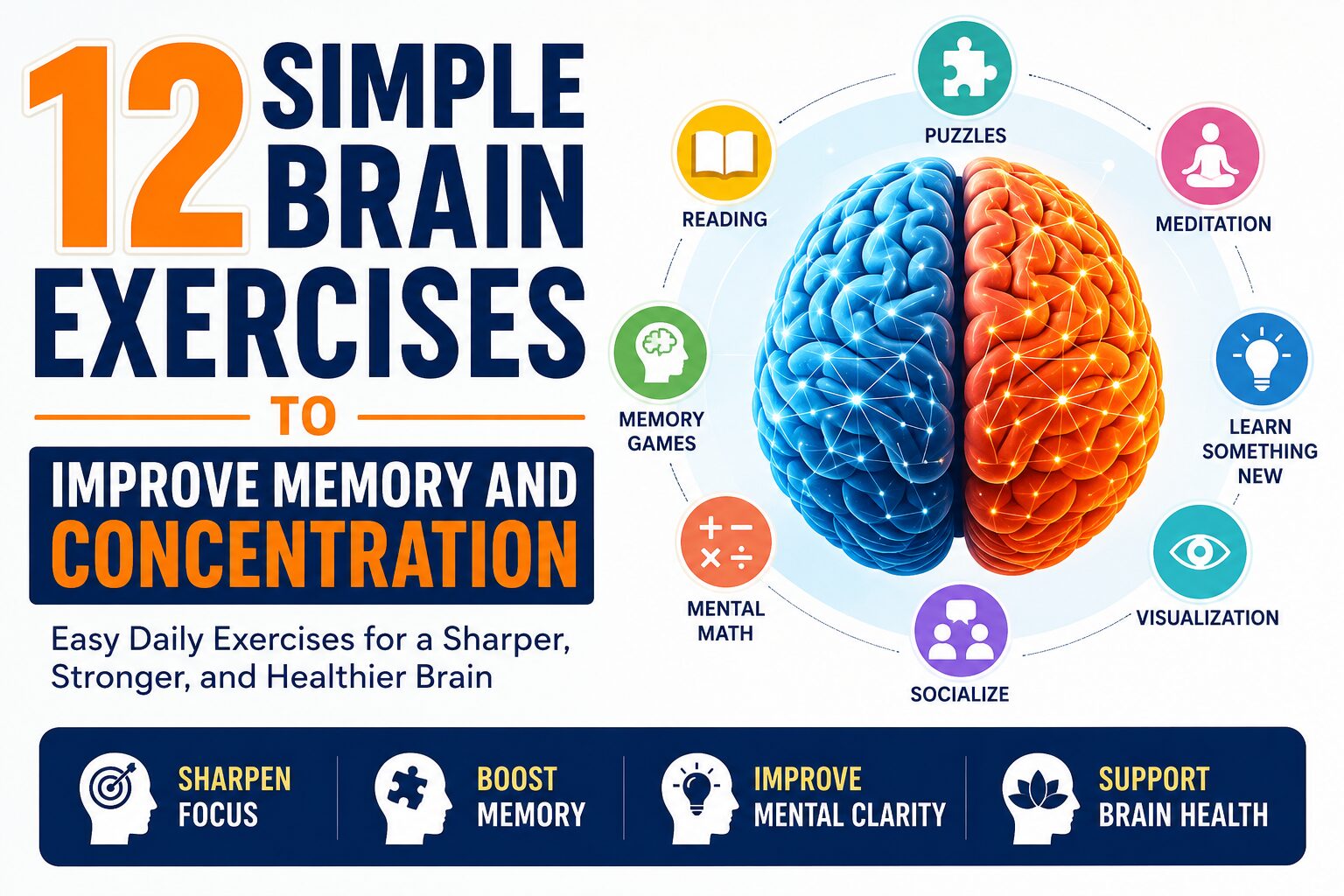
In this guide, you’ll discover 12 simple brain exercises to improve memory, along with practical tips to strengthen concentration and support long-term brain health.
Why Brain Exercises Can Improve Memory
Your brain is constantly creating and strengthening connections between nerve cells whenever you learn something new or practice a skill.
Activities that challenge your thinking encourage your brain to stay active. While brain exercises aren’t a guaranteed way to prevent memory problems or improve medical conditions, they can support healthy thinking skills and help you stay mentally engaged.
The key is consistency.
Practicing simple mental exercises for 10 to 20 minutes each day is usually more beneficial than doing a long session once a month.
1. Solve Puzzles
Puzzles are one of the easiest ways to keep your brain active.
Crossword puzzles, Sudoku, jigsaw puzzles, and logic games encourage your brain to recognize patterns, solve problems, and remember information.
How to do it:
Spend 15–20 minutes solving a puzzle several times each week.
Choose a difficulty level that challenges you without becoming frustrating.
Why it may help
Puzzles encourage different areas of the brain to work together, including memory, reasoning, and attention.
Practical Tip
Instead of using your phone while waiting in line, keep a small puzzle book with you.
2. Learn Something New
One of the best ways to exercise your brain is by learning a completely new skill.
This could include:
- Learning a new language
- Playing a musical instrument
- Trying photography
- Learning to cook new recipes
- Taking an online course
Learning unfamiliar information encourages your brain to create new neural connections.
Practical Tip
Spend just 15 minutes each day learning something you’ve never tried before. Small daily progress often works better than occasional long study sessions.
3. Practice Memory Recall
Most people consume information without actively trying to remember it.
Memory recall changes that.
Instead of immediately checking your notes or searching online, pause and try to remember the information yourself.
For example:
- Recall your shopping list before looking at it.
- Summarize a book chapter from memory.
- Try remembering names after meeting new people.
- Recall yesterday’s schedule before checking your calendar.
Why it helps? Actively retrieving information strengthens memory more effectively than simply reading it repeatedly.
Practical Tip
At the end of each day, write down three things you learned without checking your phone or notebook first.
4. Play Memory Games
Memory games are a fun way to challenge your brain while improving attention and recall. These games encourage you to remember patterns, sequences, numbers, or images, which can help strengthen short-term memory over time.
There are many ways to play memory games:
- Matching card games
- Number sequence challenges
- Word association games
- Memory apps
- Simon Says
- Chess and strategy board games
The goal isn’t to win every game—it’s to keep your brain actively thinking.
Why it may help
Memory games require your brain to store, organize, and retrieve information quickly. This regular mental practice helps keep your mind engaged.
The goal isn’t to win every game—it’s to keep your brain actively thinking.
Practical Tip
Spend about 10 minutes a day playing a memory game instead of scrolling through social media.
Try This Today: Shuffle a deck of cards, look at five cards for 20 seconds, turn them over, and see how many you can remember correctly.
5. Read with Active Focus
Reading is excellent for your brain—but reading actively is even better.
Many people read without fully paying attention. By the end of the page, they realize they don’t remember much of what they just read.
Instead, slow down and interact with the material.
Try these techniques:
- Highlight important ideas.
- Ask yourself questions while reading.
- Summarize each chapter in your own words.
- Explain what you learned to someone else.
This keeps your brain involved rather than simply letting your eyes move across the page.
Why it may help
Active reading improves both understanding and memory because your brain is processing information instead of passively receiving it.
Practical Tip
After reading for 15 minutes, close the book and write down the three most important points you remember.
Try This Today: Read one short article today and explain it aloud in your own words without looking back at the text.
6. Practice Visualization
Visualization is a simple technique that helps your brain remember information by creating mental pictures.
For example, if you’re trying to remember a grocery list that includes apples, milk, eggs, and bread, imagine:
A giant apple balancing on a bottle of milk. Eggs rolling across slices of bread.
The stranger the image, the easier it often is to remember.
Why it may help
Our brains tend to remember vivid images more easily than plain words. Visualization is widely used by students, public speakers, and people preparing for presentations because it makes information more memorable.
Practical Tip
Whenever you learn a new concept, try creating a simple mental picture that represents it.
Try This Today: Before leaving home, picture the items you need to carry. Later, see how many you remember without checking a list.
7. Practice Mindfulness Meditation
A busy mind makes it difficult to concentrate.
Mindfulness meditation helps train your attention by encouraging you to focus on the present moment.
You don’t need to meditate for an hour.
Even 5 to 10 minutes of quiet breathing can help you become more aware of distractions and gently bring your attention back.
A simple way to begin:
- Sit comfortably.
- Close your eyes.
- Breathe slowly.
- Focus on your breathing.
- When your mind wanders, gently return your attention to your breath. That’s all.
Why it may help
Regular mindfulness practice may improve attention and reduce mental distractions for some people. Many people find it easier to stay focused on work or study after making mindfulness part of their daily routine.
Practical Tip
Start with five minutes every morning and gradually increase the time if it feels comfortable.
Try This Today: Set a timer for five minutes today and focus only on your breathing. Notice how many times your mind wanders—and gently bring it back each time.
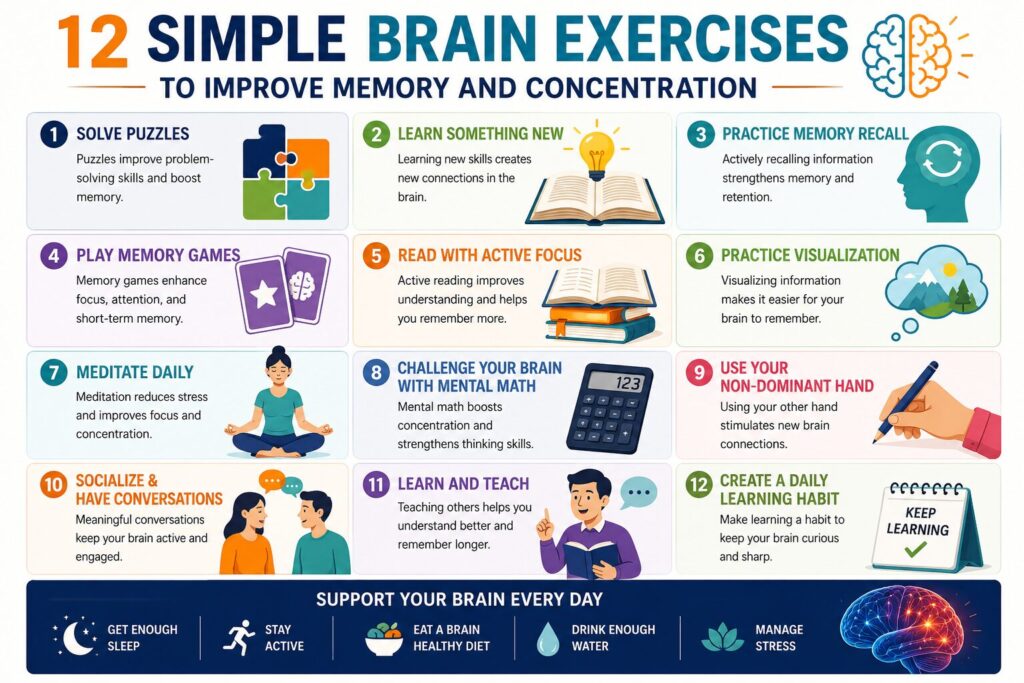
8. Challenge Your Brain with Mental Math
Many of us rely on calculators or smartphones for even simple calculations. While these tools are convenient, doing basic math in your head gives your brain a good workout.
Mental math encourages concentration, logical thinking, and working memory.
Try these exercises:
- Add grocery prices in your head while shopping.
- Calculate discounts before checking the bill.
- Multiply small numbers mentally.
- Count backward from 100 by sevens.
Why it may help
Mental calculations require your brain to process and hold information at the same time, which can improve attention and problem-solving skills.
Practical Tip
Practice mental math for just five minutes each day while waiting in line or traveling.
Try This Today: Without using your phone, calculate the total cost of three items before reaching the checkout counter.
9. Use Your Non-Dominant Hand
This may sound unusual, but using your non-dominant hand forces your brain to work differently.
Try brushing your teeth, opening doors, eating, or writing a few words with your opposite hand.
At first, it will feel awkward—but that’s exactly the point.
Why it may help
Performing familiar tasks in an unfamiliar way encourages your brain to create new connections while improving coordination and attention.
Practical Tip
Choose one simple activity each day and complete it using your non-dominant hand for five minutes.
Try This Today: Write your name five times with your non-dominant hand and notice how much concentration it requires.
10. Socialize and Have Meaningful Conversations
Talking with friends and family does more than improve your mood—it also challenges your brain.
Conversations require you to:
- Listen carefully.
- Remember details.
- Respond thoughtfully.
- Solve problems.
- Understand emotions.
All of these activities engage different parts of the brain.
Why it may help
Regular social interaction keeps your brain active and mentally engaged while reducing feelings of isolation.
Practical Tip
Schedule regular conversations with family or friends instead of relying only on text messages.
Try This Today: Call a friend or family member and have a meaningful 15-minute conversation without checking your phone.
11. Learn and Teach
One of the best ways to remember something is to teach it to someone else.
When you explain a topic in your own words, your brain organizes the information more effectively.
You don’t have to be an expert. Simply explaining a new recipe, hobby, or interesting fact to a friend helps reinforce your own understanding.
Why it may help
Teaching encourages active recall, logical thinking, and deeper understanding.
Practical Tip
Whenever you learn something interesting, explain it to another person within 24 hours.
Try This Today: Read one useful article and summarize it in your own words to a family member or friend.
12. Create a Daily Learning Habit
Your brain enjoys variety.
Learning something new every day keeps your mind curious and engaged. It doesn’t have to be complicated.
You might:
- Read a chapter from a book.
- Watch an educational documentary.
- Learn five new vocabulary words.
- Explore a historical event.
- Discover an interesting scientific fact.
Why it may help
Daily learning encourages continuous mental stimulation and helps prevent your routine from becoming repetitive.
Practical Tip
Set aside 20 minutes each day for learning something that genuinely interests you.
Try This Today: Before going to bed tonight, write down one new thing you learned today.
If you enjoy structured mental exercises and want a guided approach to improving your cognitive skills, you may find our Neuro Energizer Review helpful. In that review, we explain how the program works, who it’s designed for, and whether it’s worth considering.
Daily Habits That Support Better Brain Health
Brain exercises work best when combined with healthy daily habits.
Nutrition also plays an important role in supporting brain function. Read our guide on Best Foods for Brain Health to discover foods that may help keep your mind healthy.
Here are a few lifestyle practices that can support memory and concentration:
Get Enough Sleep
Sleep plays an important role in learning and memory. Most adults benefit from getting adequate, consistent sleep each night.
Stay Physically Active
Walking, cycling, swimming, and other forms of exercise increase blood flow throughout the body, including the brain.
Aim for at least 30 minutes of moderate physical activity on most days of the week.
Eat a Balanced Diet
Smoothies can also be an easy way to include more fruits in your diet. Here are our Best Fruits for Weight Loss Smoothies.
A diet rich in fruits, vegetables, whole grains, healthy fats, and lean protein provides nutrients that support overall brain health.
Foods such as berries, leafy greens, walnuts, fish, and eggs are commonly included in brain-friendly eating patterns.
Drink Enough Water
Even mild dehydration can make it harder to concentrate.
Keep a water bottle nearby and drink regularly throughout the day.
Manage Stress
Long-term stress can affect attention and memory.
Simple activities such as deep breathing, meditation, walking, or spending time outdoors may help reduce stress for many people.
Common Mistakes That Can Affect Memory and Concentration
Sometimes, improving your memory isn’t about doing more—it’s about avoiding habits that interfere with focus.
Trying to Multitask
Doing several tasks at once often reduces concentration. Focus on one task before moving to the next.
Spending Too Much Time on Social Media
Constant notifications and endless scrolling can interrupt attention and make it harder to stay focused.
Skipping Sleep
Late nights may seem productive, but poor sleep can make learning and remembering information more difficult.
Ignoring Physical Activity
A sedentary lifestyle affects both physical and mental well-being. Even a short daily walk can make a difference.
Expecting Instant Results
Brain exercises require consistency. Just like physical fitness, improvements usually happen gradually rather than overnight.
A Quick Reminder
No single exercise can dramatically improve memory on its own. The best results come from combining several healthy habits and practicing them consistently over time.
When Should You Consider a Brain Training Program?
Simple brain exercises and healthy lifestyle habits are an excellent place to start. For many people, these daily practices are enough to keep the mind active and improve focus over time.
However, some people prefer a more structured approach.
If you enjoy guided lessons, interactive activities, and a step-by-step program, a brain training course may help you stay consistent with your practice.
At CB Shopper, we’ve reviewed several digital products designed to support memory and cognitive skills. If you’re interested in learning more, you can read our detailed Neuro Energizer Review, where we explain what the program includes, who it may be suitable for, and its pros and cons.
Remember, no program can replace healthy habits like quality sleep, regular exercise, and a balanced diet. Think of brain training as one part of an overall approach to supporting brain health.
Final Thoughts
Improving your memory and concentration doesn’t happen overnight, but small daily actions can add up over time.
Whether you choose to solve puzzles, learn a new skill, practice mindfulness, or simply read more actively, every effort helps keep your brain engaged.
The most important thing is consistency.
You don’t need to complete all 12 exercises every day. Pick two or three that fit your routine and practice them regularly. Over time, these habits can become part of a healthier lifestyle that supports both your mind and overall well-being.
If you found this guide helpful, consider exploring our other Brain Health articles for more practical tips and product reviews.
Frequently Asked Questions
Some of the most effective exercises include solving puzzles, learning new skills, practicing memory recall, visualization, mindfulness meditation, reading actively, and playing memory games.
Everyone is different. Some people notice better focus after a few weeks of consistent practice, while others may take longer. The key is making brain exercises part of your daily routine.
Brain exercises help keep your mind active, but they cannot guarantee the prevention of memory-related conditions. If you’re experiencing significant or worsening memory problems, consult a healthcare professional for evaluation.
Some people find brain training apps enjoyable and motivating. They can be one way to challenge your thinking, but they work best when combined with healthy lifestyle habits rather than used as a standalone solution.
Reading regularly encourages concentration, vocabulary, and learning. Actively engaging with what you read—such as summarizing or discussing it—can help reinforce memory.
Many people find mindfulness meditation helpful for reducing distractions and improving focus. Even a few minutes of daily practice may make it easier to concentrate.
Regular physical activity supports overall health and increases blood flow throughout the body, including the brain. It is often recommended as part of a healthy lifestyle that supports cognitive well-being.
A balanced diet that includes fruits, vegetables, whole grains, healthy fats, fish, nuts, seeds, and leafy greens can provide nutrients that support overall brain health.
Most adults generally benefit from getting around 7–9 hours of quality sleep each night, though individual needs may vary.
Yes. Ongoing stress can make it harder to concentrate and remember information. Managing stress through relaxation techniques, exercise, and adequate rest may help improve focus.
Today’s Brain Health Checklist
Today’s Brain Health Checklist
Conclusion
Your brain is one of your body’s most valuable assets, and taking care of it doesn’t have to be complicated. This simple brain exercises to improve memory is much easier to follow and helps you to keep your mind active and continue learning throughout life.
Start with one or two exercises today, stay consistent, and gradually build a routine that works for you. Small improvements made regularly often have a greater impact than occasional intense efforts.